


 Lecture
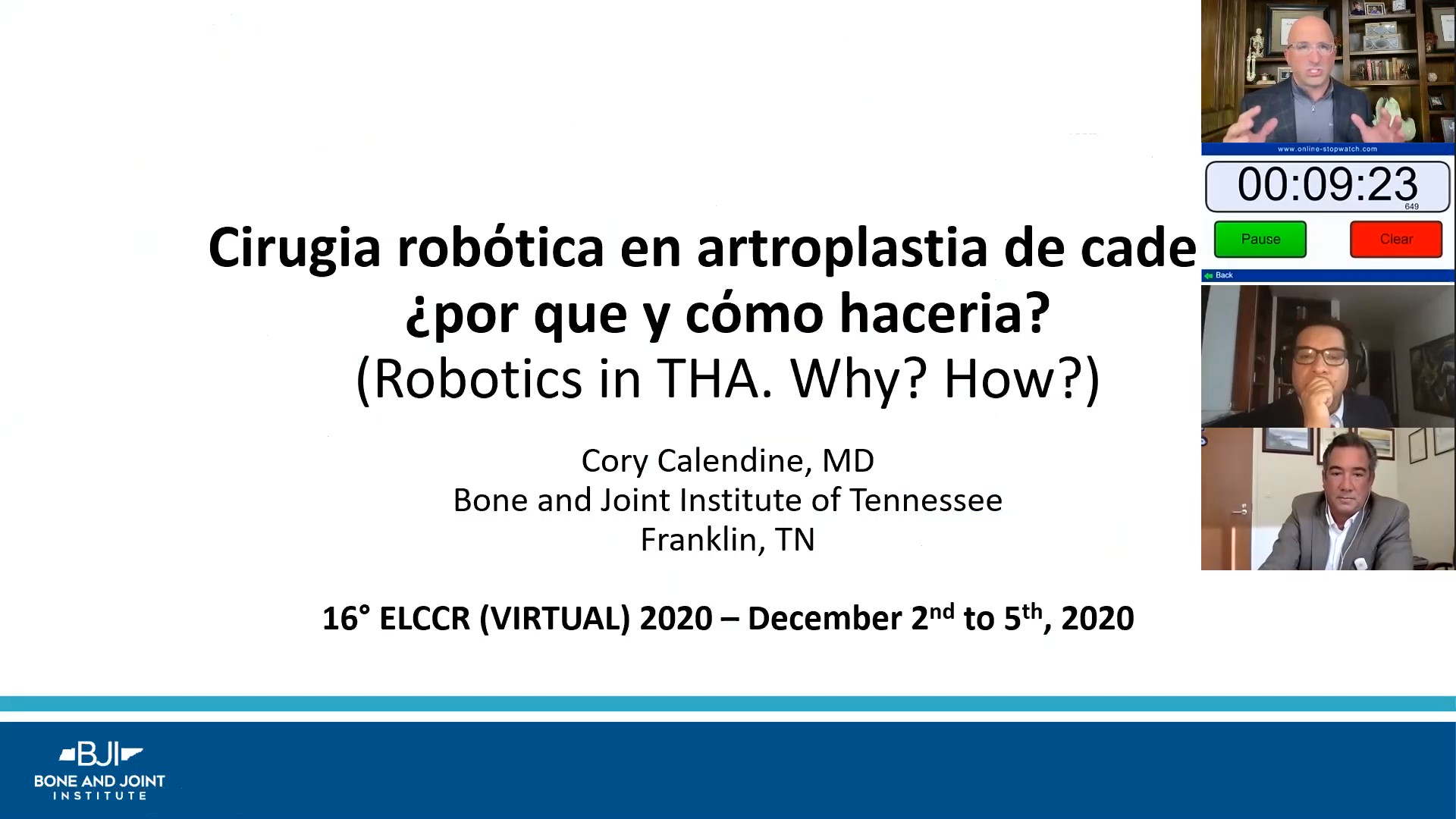
(2020) Robotics in THA: Why? How?
Current status of the use of robotics in Total Hip Replacement looking at the US experience.
This lecture was published as a recording without a written summary.
1,778 words · 10 min
Hey guys, I hope all is well. This is my first contribution to Doc Social and I'm honored to be asked to participate in this new platform. Today, I want to talk a little bit about Haptic Robotics. My name's Corey Callendine. I practice with the Bone and Joint Institute of Tennessee in Franklin just outside of Nashville. I really want to talk about Mako SmartRobotics, that particular platform.
So these are my disclosures. I'm a consultant for Stryker, also an equity partner in an ASC that owns a Mako system.
Let's look at a video first. So these are the steps. Preoperatively, there is a CT scan, you get a preoperative plan so you can plan in three-dimensional space. You can see the CT images there. Otherwise, the setup is pretty normal.
These are two pins I'm placing in the mid-shaft of the tibia. Then I'll place two pins in, uh, in the femur. Intra-incisional is what I'm showing you here. I then tighten these arrays into place. This is, this is critical because we have to know where the bone is in space, of course. Now, I'm gonna take Hip center and medial lateral malleus. It's important to note that all these points are being.
Check back to the CT scan. So this is very different than our typical navigation scenario. These are 40 points I'm taking on the femur and 8 validation spheres. I'm gonna do those same steps on the tibia, 40 points and then 8 validation spheres. Again, everything gets checked back to the CT scan. If I'm off, it will tell me and not allow me to proceed.
I then remove the osteophytes, resect the ACLPCL, anything that's gonna affect soft tissue balance, then I can see kind of where this Knee is starting. You can see me getting things out of the way, so I can just see the resting position of the Knee and you can see this Knee has a little bit of varis but not, not really too deformed.
The key here with uh Mako and with any of these platforms is we really want to know what the ligament tension is so we can make those intraoperative adjustments. This is pre-resection balancing, so I haven't made any cuts here. I'm placing spoons in the lateral and medial uh joint surfaces to tension the ligaments and then I can capture those poses if you will. These are the same, uh, steps that I'm doing here now inflection, the lateral side first and then medially.
I'm just trying to tension the mediallateral ligaments equally, save that pose, and then I can make some adjustments to my implants. That's actually not how I do it. That's pre-resection. This is how I do it. I do my tibial resection first. You could see the robotic arm, brings me into the cut plane and then cutting the tibial bone. I'm actually not looking into the wound. I'm looking at the screen, removing the green bone if you will. The reason why I take the
Be out as I want to do a technique called mid resection so I can place this tensioner now. I have room in the joint. I can squeeze and it tensions the medial and lateral uh joint space at the same time. So the medial lateral ligaments are both tensioned at the same time with one tensioner. I can then save that posture. I'll take the tension off, flex the Knee up, place that same tension, uh, through the tensioner. You'll see me, um.
Do the exact same steps here, so I squeeze with the same tension. I can then save those uh tension postures and then make adjustments to my implants as I see fit. You know, total Knee is not just a, um, bony procedure, it's also a soft tissue procedure. So I have to know what the ligaments are doing.
I can make intraoperative adjustments. Now, this is, this is critical here because, uh, otherwise, I can't have my final position. This is really kind of predicting the future. So, I'm making adjustments to the implants intraoperatively in three-dimensional space and I'm doing this before I cut my femur, so I'm kind of predicting what my final balance will be.
Once I'm done with my adjustments, I can look back at the CT scan and see which of those uh staples in this case needs to be removed. I'm then gonna finish my femur, so I predicted the future. Now I'm gonna cut, uh, the, the, the femur consistent with my plan. You know, that's really the third pillar of Mako SmartRobotics. First pillar is preoperative planning. Second pillar is intraoperative adjustments, and then.
Finally, um, executing the plan with the robotic arm. So that's what I'm, that's what I'm doing here. Once I've done that, I simply clean up the Knee and then I have the ability to place trials just like I do with a manual case. So I place trials into the Knee and I still get that same feel, you know, we all know how we want the Knee to feel. Mako is really there to execute your plan.
Plan in your field, you can see me take it through a range of motion. I'm getting numbers up on the screen at this point and I could have added that window here, but I, I, I'm also getting my own, uh, my, my own field to make sure I've ended just the way I like to end. I then simply remove the pins from the femur, remove them from the tibia, um, and, and, and, and close the incision after final implants are in place.
I want to look at a couple of case studies just to demonstrate this platform, uh, a little bit more clearly. Advanced imaging, we've talked about that several times. The importance of advanced imaging here is that we have a pre, preplan and in this case, I can see what metal needs.
Needs to come out, but also you have to have a CT scan preoperatively to have haptic control. So with this system, you have a cutting blade and you can see that border there. The saw simply doesn't operate outside that border, so there's a level of protection.
The Other thing is everything gets checked back to the, the truth if you will, the preoperative imaging, the preoperative CT scan. The difference between these two images is only the Hip SIPs, Hip center registration. So on the left, you can see yellow dots. I'm really haven't found that femur perfectly in three-dimensional space on the right. All I've changed.
It's the center of rotation of the Hip and you can see now those same dots are green because I've perfected it back to the CT scan. It will stop you if you're not lining up with your preoperative CT scan. Let's look at two cases quickly. One first ofvalgus, uh, a case that I do not want to change my mechanical alignment.
This is me intraoperatively. I've already cut my tibia. I placed my tensioner, and these are the numbers. See the, the box at the bottom right there. You can see I'm looser medially than laterally. In this case, I, I, I went ahead and did a soft tissue release at this point. I released the tissues laterally and then re-tensioned the Knee. You can see that fixed my imbalance and extension, but I'm still not quite there in flex.
I make a slight adjustment to the femur. I internally rotated the femur in this case, one degree to the trans epicondyle axis to achieve a balanced Knee. Now, I know that's a little bit uh unusual, certainly seems a little bit unusual, but I wanted to end with a balanced Knee. I made all my cuts. I trialed, made sure my patellar tracking was appropriate. This patient is doing quite well.
Here's a complex varis case. This is obviously a case of proximal tibial deformity. This is a Paget, uh, Paget's disease of the proximal tibia. These are the AP and lateral views of the tibia. You can see how much deformity there is, uh, of the tibia and, uh, certainly advanced imaging, uh, can help here. Here's our 3D plan preoperatively. Want to make sure that tibial cut we make accommodates.
Uh, the keel of the implant, uh, and you can see that, uh, all laid out here again, preoperatively. This is intraoperatively. This is prior to any resection of the tibia. You can see how tight he is medially. Uh, we dis, uh, we discussed earlier, my tendency is to cut the tibia first and because there was so much deformity, I cut this tibia first in 2 degrees of varis. I made sure that.
That cut was gonna allow the uh keel to rest within the bone. I made the tibial cut and then tension the Knee and you can see how still I'm very, very tight medially. I then did a posterior medial tibial reduction osteotomy uh and uh I made some femoral adjustments to make sure that I was gonna end um with a balanced Knee. This is the final femoral plan. Here, here.
Here's the point. The preoperative plan based on CT scan and then the final intraoperative plan is always different because again, I'm making those adjustments intraoperatively. That's the second pillar of the Mako SmartRobotics platform and ultimately, I'm executing with the robotic arm. This is with the trials in place and you can see I've achieved a balanced Knee.
These are, uh, actually, I think these are his post-operative, uh, uh, recovery room films, uh, they're on the left and his long leg alignment.
Films at about 6 weeks. He's uh 6 months out now doing uh quite well. Now, in truth, this is one robotic platform. There's really been a proliferation of Robotics, and I think it's really important to start, um, classifying these systems to, to, to define what it means to be robotic, and, and that will allow us not only to compare system against system, but also see which elements of a robotic.
Robotic platform are critical which elements are important to move the needle to improve the patient outcome and that's obviously what we're all about. I hope this was helpful to you. I hope you'll reach out if you want to talk further about smart Robotics or really any robotic platform. I think there are more questions than answers in, in, in, in, in this particular field at this time. I hope it was helpful. Uh, have a great day.
Automatically transcribed and not checked by a person — it may contain errors, particularly in names, drugs and dosages. The recording is the source.
5 questions on what was actually said in this recording, and we remember how you did. Sign in to take it — an account is free, and nothing else on doc.social asks for one.
AI-generated from this recording’s transcript, not written by the speaker. Tell us if a question misreads what was said.
LectureCurrent status of the use of robotics in Total Hip Replacement looking at the US experience.
 Lecture
There is currently a paucity of data analyzing total joint arthroplasty (TJA) disparities among patients with active cancer diagnoses.
Surgery triggers a series of inflammatory, immune, and metabolic responses. The stress response leads to an increase in protein breakdown that outpaces protein synthesis. The body's natural store of essential amino acids exit skeletal muscl…